
Can I Use A 4 Channel Amp For A Subwoofer: Setup Tips
Introduction
Yes, you can use a 4-channel amplifier for a subwoofer in a U.S. car audio system. The usual method is to bridge two channels into one stronger output for the subwoofer. The other two channels can power your front speakers or rear speakers.
This setup can work well when the amplifier supports bridging, the subwoofer has the right impedance, and the amp delivers enough RMS power. However, a dedicated mono subwoofer amplifier is often the better choice for a large or power-hungry sub.
How a 4-Channel Amp Can Power a Subwoofer
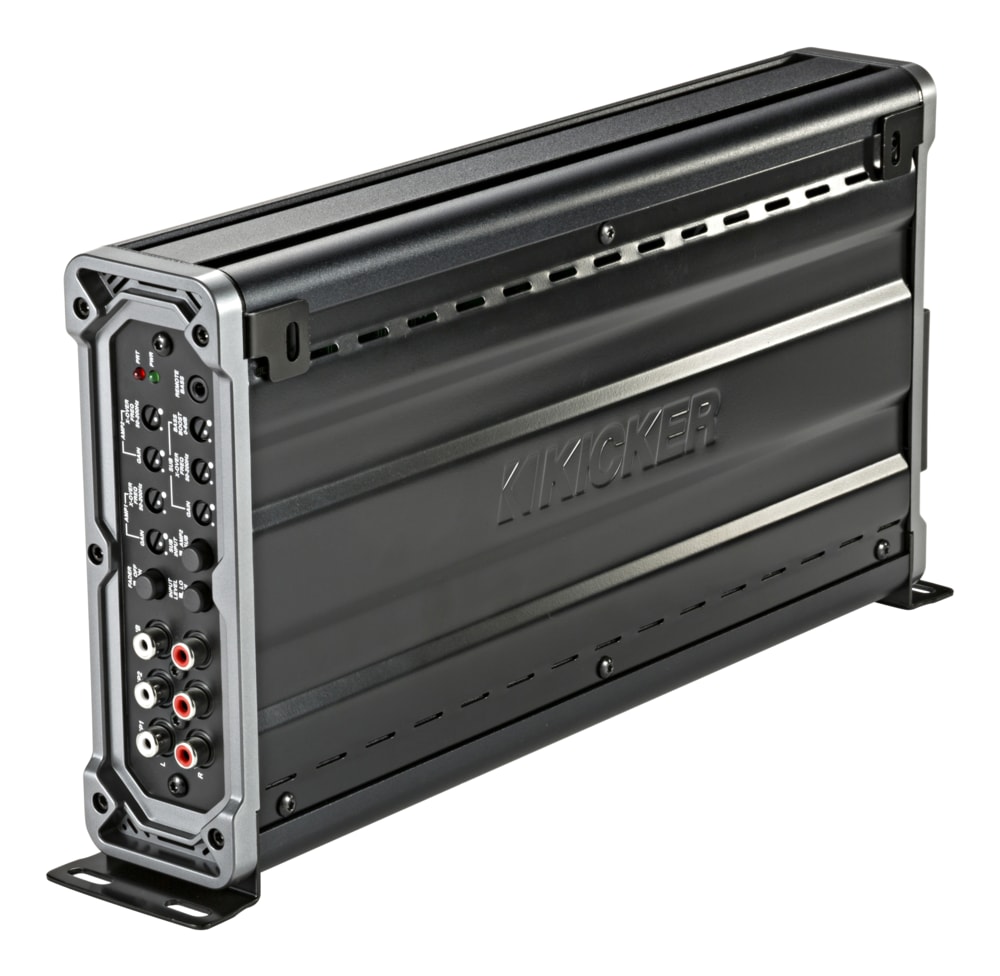
A 4-channel amplifier has four separate output channels. Each channel normally powers one speaker. For example:
- Channel 1 powers the left front speaker.
- Channel 2 powers the right front speaker.
- Channel 3 powers the left rear speaker.
- Channel 4 powers the right rear speaker.
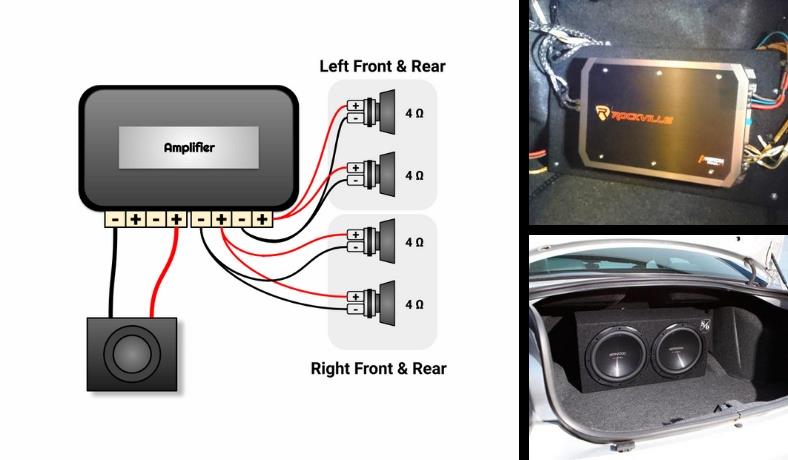
Many 4-channel amps can combine two channels into one bridged channel. Bridging uses the voltage from two amplifier channels to produce more power for one speaker or subwoofer.
A common layout is:
| Amplifier channels | Typical use |
|---|---|
| Channels 1 and 2 | Front speakers |
| Channels 3 and 4, bridged | One subwoofer |
This lets one amplifier run the main speakers and a subwoofer. It can save space, wiring, and installation cost.
What “bridging” means
Bridging does not mean connecting two positive terminals together. Instead, you connect the subwoofer to the specific bridged positive and negative terminals shown in the amplifier manual.
On many amps, the wiring looks similar to this:
- Subwoofer positive wire: Channel 3 positive
- Subwoofer negative wire: Channel 4 negative
The exact terminals vary by brand and model. Some amplifiers label the terminals as “BRIDGED.” Others show a diagram near the speaker outputs.
Always follow the wiring diagram for your exact amplifier. Connecting the wrong terminals can damage the amplifier or subwoofer.

When a 4-Channel Amp Is a Good Choice
A 4-channel amp is a practical choice when you want a simple system with moderate bass. It works especially well in a compact daily driver, truck, or SUV with a single modest subwoofer.
A bridged 4-channel amp may suit you if:
- You want to power four speakers and one subwoofer.
- Your subwoofer needs moderate power.
- You have limited room for extra amplifiers.
- The amplifier supports bridged operation.
- The subwoofer impedance matches the amp’s bridged rating.
- You want a cleaner installation with fewer components.
For example, a 4-channel amp rated at 75 watts RMS per channel at 4 ohms may produce roughly 200 watts RMS when two channels are bridged. The exact output depends on the amplifier design and its specifications.
That power level may work well for a single 8-inch or 10-inch subwoofer designed for moderate power. It may not be enough for a large 12-inch or 15-inch subwoofer that needs 500 watts RMS or more.
When it is not the best choice
A 4-channel amp may not be suitable when:
- The subwoofer needs much more power than the bridged channels provide.
- You want maximum low-frequency output.
- You plan to run two large subwoofers.
- The amplifier cannot handle the subwoofer’s impedance.
- You want independent control over the speakers and subwoofer.
- The amp becomes hot, clips, or shuts down during use.
A mono subwoofer amplifier usually offers more efficient power delivery, better low-pass control, and a design made for bass frequencies. That does not make a 4-channel amp wrong. It simply means the mono amp may be a better match for a larger system.

Check These Specifications Before Connecting the Subwoofer
The most important step is comparing the amplifier and subwoofer specifications. Do not judge compatibility by peak watts alone.
1. Confirm that the amp supports bridging
Look for terms such as:
- Bridged output
- Bridge mode
- 2-channel bridged power
- Bridgeable channels
- RMS power at 4 ohms bridged
If the manual does not show a bridged wiring diagram, do not assume the amplifier supports it.
Some 4-channel amps allow channels 3 and 4 to be bridged. Others allow channels 1 and 2, or both pairs. A few models are not bridgeable at all.
2. Match RMS power, not peak power
RMS power is the useful rating for normal system design. Peak or maximum power is a short-term figure and is less useful for matching equipment.
Compare:
- The amplifier’s bridged RMS output.
- The subwoofer’s RMS power rating.
- The subwoofer’s nominal impedance.
A subwoofer rated at 300 watts RMS does not require exactly 300 watts. An amplifier that supplies less power can still operate it safely if you avoid heavy clipping. However, the system may not reach the subwoofer’s full output potential.
An amplifier that supplies more RMS power can also work, provided you set the gain correctly and stay within the subwoofer’s limits.
3. Confirm the impedance
Impedance is the electrical load, measured in ohms. Common car subwoofer ratings include:
- 2 ohms
- 4 ohms
- Dual 2 ohms
- Dual 4 ohms
Many bridged 4-channel amplifiers require a 4-ohm minimum load. Connecting a 2-ohm subwoofer to a bridged pair may force the amp to work beyond its safe limit.
Possible results include:
- Excess heat
- Protection mode
- Distorted sound
- Blown fuses
- Permanent amplifier damage
Some newer amplifiers can safely handle a 2-ohm bridged load, but this is model-specific. Check the manual before making the connection.
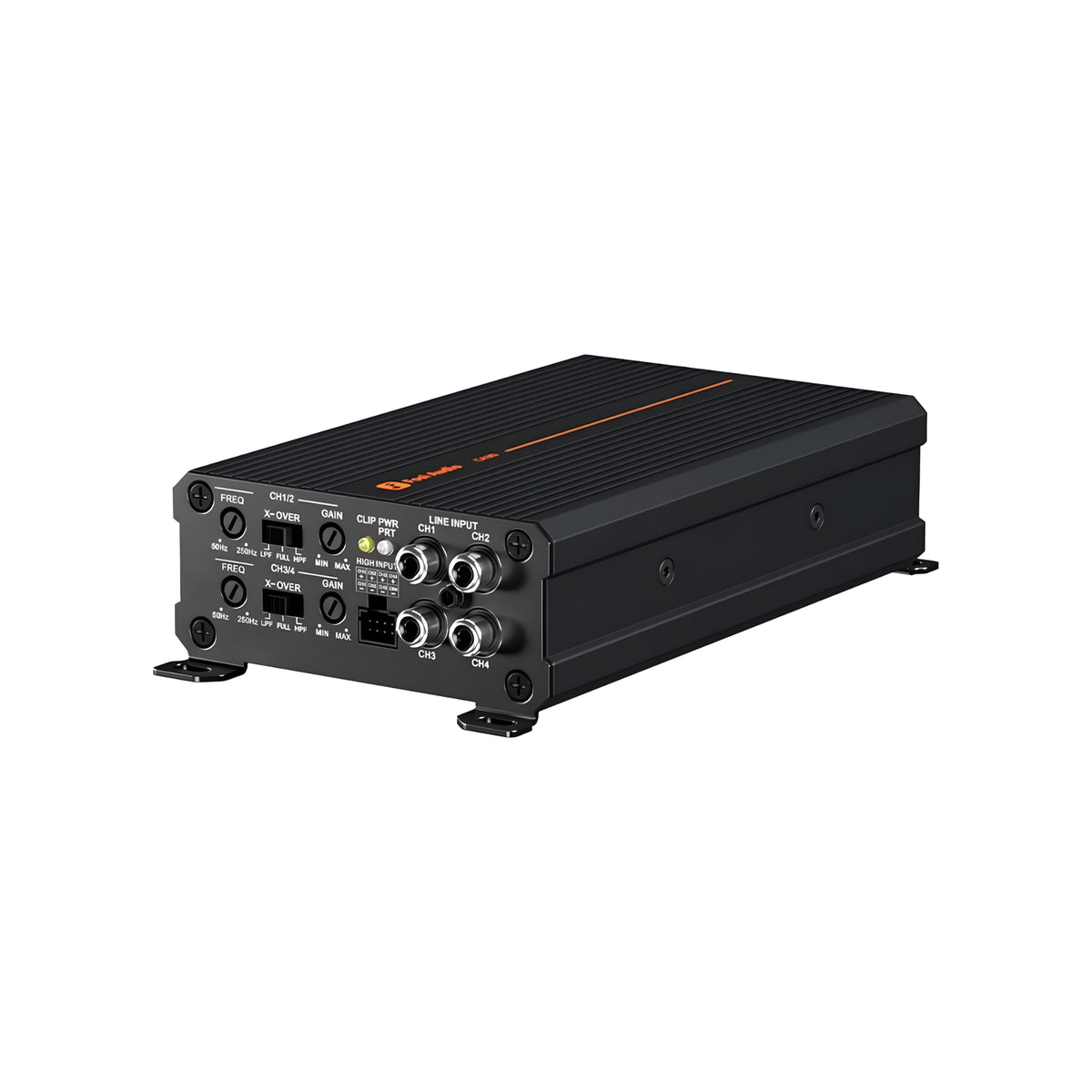
4. Check the amplifier’s frequency controls
A subwoofer should receive low frequencies, not the full range of music. The amplifier should have a low-pass filter, often marked “LPF.”
A low-pass filter blocks higher frequencies from reaching the subwoofer. A common starting range is about 70 to 90 Hz, followed by listening and adjustment.
You may also need:
- Gain control
- Bass boost control
- Phase switch or phase control
- Subsonic filter, especially with a ported enclosure
Bass boost should not be used to fix a weak system. Too much boost can cause clipping and excessive cone movement.
Simple Power and Impedance Examples
These examples are hypothetical. Use your amplifier’s own manual for the final connection.
Example 1: A good match
- 4-channel amp: 75 watts RMS per channel at 4 ohms
- Bridged output: about 200 watts RMS at 4 ohms
- Subwoofer: 4 ohms, 250 watts RMS
This is generally a reasonable match for a moderate subwoofer. The amplifier supplies slightly less than the subwoofer’s rated capacity, so the user should avoid turning the gain up to compensate.
Example 2: An unsafe load
- Bridged amplifier minimum: 4 ohms
- Subwoofer: 2 ohms
This is not a safe match unless the manufacturer specifically approves a 2-ohm bridged load. The lower impedance can demand more current than the amplifier can handle.
Example 3: A weak match
- Bridged amplifier output: 150 watts RMS
- Subwoofer: 600 watts RMS
The subwoofer may produce sound, but the amplifier will not use the subwoofer’s full capability. Turning the gain too high may cause clipping. A dedicated mono amplifier would likely be a better fit.
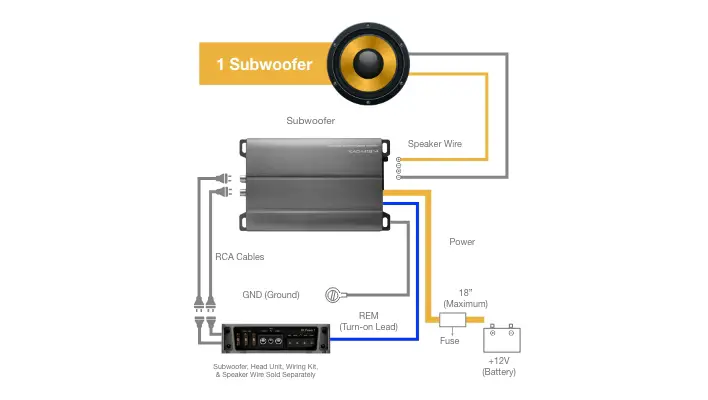
How to Wire a Subwoofer to a 4-Channel Amp
Before wiring, turn off the vehicle and disconnect the negative battery terminal. Use the amplifier manual as the primary guide because terminal layouts differ.
Step 1: Confirm the equipment
Check all of the following:
- The amp supports bridging.
- The bridged load matches the subwoofer impedance.
- The subwoofer is wired correctly if it has dual voice coils.
- The power and ground cables meet the amplifier’s requirements.
- The fuse is installed near the battery.
- The enclosure is suitable for the subwoofer.
Step 2: Choose the channels
Most installations use channels 3 and 4 for the subwoofer. This leaves channels 1 and 2 available for the front speakers.
Some amplifiers recommend using channels 1 and 2 for bridging. Follow the printed diagram or manual rather than relying on a general wiring pattern.
Step 3: Connect the speaker wires
Connect the subwoofer only to the amplifier’s marked bridged terminals. Do not connect the subwoofer to all four channels.
Do not connect speaker negative wires to the vehicle chassis unless the amplifier manual specifically instructs you to do so. Modern car amplifiers normally use isolated speaker outputs.
Step 4: Set the crossover
Set the bridged pair to low-pass mode. Start with the low-pass frequency near 80 Hz.
Set the other two channels to high-pass mode if they power door speakers. A starting point near 70 to 100 Hz can reduce deep bass strain on small factory or aftermarket speakers.
Step 5: Set the gain correctly
Gain is not a volume control. It matches the amplifier’s input sensitivity to the signal from the head unit.
A safe setup is:
- Set the head unit’s bass boost and loudness controls to flat.
- Set the amplifier gain low.
- Play a clean test track.
- Raise the head unit volume to a high but clean level.
- Slowly increase the amplifier gain.
- Stop when the bass becomes harsh, compressed, or distorted.
- Reduce the gain slightly.
If you use a multimeter or oscilloscope, you can set the output more precisely. For a target RMS voltage, use:
Voltage = √(Power × Impedance)
For example, 200 watts RMS into 4 ohms requires:
√(200 × 4) = 28.3 volts AC
This calculation assumes the amplifier can produce that power cleanly at that load. It does not replace the manufacturer’s limits or a proper distortion check.

A 4-Channel Amp With Two Subwoofers
A 4-channel amp may run two subwoofers, but the wiring becomes more complex. You must consider the number of voice coils, the final impedance, and whether each channel can handle the load.
Possible arrangements include:
- One subwoofer on each channel pair.
- Two subwoofers wired to one bridged pair.
- One subwoofer on each individual channel.
- Two subwoofers connected in a series or parallel configuration.
The final impedance must remain within the amplifier’s rated range. For example, two 4-ohm subwoofers wired in parallel create a 2-ohm load. That may be acceptable on individual channels, but it may be unsafe on a bridged pair unless the manual approves it.
A dual-voice-coil subwoofer needs special care. The two voice coils must receive the same signal and be wired in a way that produces a safe final impedance. When the wiring is unclear, use the subwoofer manufacturer’s wiring chart or ask a qualified car audio installer.
4-Channel Amp vs. Mono Amp for a Subwoofer
The better amplifier depends on the system goal.
| Feature | 4-channel amplifier | Mono subwoofer amplifier |
|---|---|---|
| Main purpose | Speakers and moderate bass | One or more subwoofers |
| Installation | Can run several speaker groups | Usually simple subwoofer wiring |
| Space | May save room | Requires an additional amp if speakers also need power |
| Bass power | Often moderate when bridged | Commonly higher and more scalable |
| Impedance options | Vary by model | Often designed for low-ohm subwoofer loads |
| Controls | May have limited bass controls | Usually stronger subwoofer-focused controls |
| Best fit | Small or medium systems | Larger or bass-focused systems |
Choose a bridged 4-channel amp when space and simplicity matter. Choose a mono amp when the subwoofer is the main priority or needs substantial power.
A separate amplifier also makes troubleshooting easier. Speaker channels and subwoofer settings remain independent, which can help when you want different crossover points or gain levels.
Common Problems and What They Mean
The amplifier goes into protection mode
Possible causes include:
- The subwoofer impedance is too low.
- Speaker wires are touching.
- The amplifier is overheating.
- The power or ground connection is poor.
- The bridged terminals are wrong.
- The amplifier has an internal fault.
Turn the system off before inspecting the wiring. Do not repeatedly reset an amp that enters protection mode.
The subwoofer sounds weak
Check:
- The bridged terminals.
- The low-pass filter.
- The subwoofer polarity.
- The gain setting.
- The head unit’s subwoofer level.
- The enclosure size and design.
- The amplifier’s actual RMS output.
A subwoofer wired out of phase with the main speakers can sound thin around the crossover region. Reverse the subwoofer polarity only as a test, then keep the setting that produces stronger, smoother bass.
The subwoofer sounds distorted
Distortion may come from:
- Too much gain
- Excessive bass boost
- A clipped signal from the head unit
- An amplifier that is too small for the desired volume
- A damaged subwoofer
- A loose or damaged speaker wire
Reducing the gain and bass boost is the first safe check. More volume is not always more bass. Once the signal clips, the sound becomes harsh and the subwoofer may heat up.
The amp becomes very hot
Some heat is normal, especially in a tight installation. Excessive heat can indicate:
- A load below the rated impedance
- Poor ventilation
- A weak ground
- A damaged speaker
- Continuous high-volume use
- An undersized power cable
Mount the amplifier where air can move around it. Do not cover it with carpet, insulation, or loose trim.
Safety and Installation Limits
Car audio amplifiers draw high current from a 12-volt electrical system. A poor installation can damage equipment or create a fire risk.
Use these basic precautions:
- Install the main fuse close to the battery.
- Use power wire sized for the amplifier’s current demand and cable length.
- Secure the power cable away from sharp metal edges.
- Protect cables that pass through the firewall with grommets.
- Make the ground connection short, secure, and free of paint.
- Do not replace a fuse with a larger fuse than the manufacturer specifies.
- Do not run power and speaker wires where they can be crushed.
- Disconnect the battery before major wiring work.
- Stop if a cable becomes hot or a fuse keeps blowing.
A professional installer can help when the vehicle has a complex factory audio system, active noise cancellation, a high-voltage hybrid system, or limited space for proper wiring.

Frequently Asked Questions
Can I bridge all four channels to one subwoofer?
Usually, no. Most 4-channel amplifiers are designed to bridge channels in pairs, not all four channels into one output. Bridging all four channels without specific manufacturer instructions can damage the amplifier.
Can I run a subwoofer and four speakers from the same 4-channel amp?
Not at full power with the standard four channels. A common setup is two channels for the front speakers and two bridged channels for one subwoofer. The rear speakers may remain on the factory radio or another amplifier.
Can I connect a 2-ohm subwoofer to a bridged 4-channel amp?
Only if the amplifier manual says it supports a 2-ohm bridged load. Many 4-channel amps require 4 ohms when bridged. Check the exact model before connecting the subwoofer.
Will a 4-channel amp damage my subwoofer?
It can if the wiring creates an unsafe impedance, the amplifier clips badly, the gain is too high, or the subwoofer receives more power than it can handle. Correct impedance and careful gain setup reduce the risk.
Do I need a capacitor for a 4-channel amp and subwoofer?
Usually, no. A capacitor does not correct an undersized power cable, weak battery, poor ground, or inadequate alternator. Fix the electrical system and wiring first. A qualified installer should assess serious voltage-drop problems.
Is a mono amp louder than a bridged 4-channel amp?
Not automatically, but a mono amp is often better suited to high-power bass. The real difference depends on RMS output, impedance, enclosure design, electrical supply, and gain settings.
Final Recommendation
You can use a 4-channel amp for a subwoofer when it is bridgeable, the subwoofer impedance is safe, and the bridged RMS output suits the subwoofer. For many U.S. car audio systems, two channels for the front speakers and two bridged channels for one moderate subwoofer is a sensible layout.
Before wiring anything, check the amplifier manual for the bridged terminals and minimum impedance. If the subwoofer needs substantial power or you want strong, adjustable bass, use a dedicated mono subwoofer amplifier instead.

Everett Calloway is a consumer electronics writer and technology enthusiast at ElectroDoz. He enjoys exploring the latest gadgets, electronic devices, and innovative technologies that make everyday life easier. Everett focuses on creating helpful product reviews, detailed buying guides, practical how-to articles, and troubleshooting tips. His goal is to simplify complex technical information and help readers understand product features, compare their options, and make informed purchasing decisions. When he isn’t researching new electronics, he enjoys exploring emerging technology trends and discovering useful gadgets.